_WW1269115%202.png)




.png)
MANAGING THE SAND BUDGET
© Thomas Cristofoletti / WWF-US
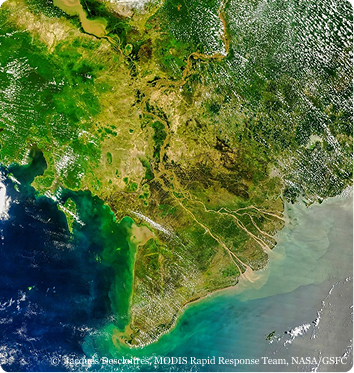
The concept of a Sand Budget — tracking the movement, storage, and extraction of sand within a river system — has long been recognized as essential for understanding and managing sediment dynamics. However, applying this concept at the scale of a large, complex river delta had never been fully realized due to significant technical and logistical challenges.
Large deltas involve intricate networks of river channels, variable sediment transport processes, and limited data availability. This makes comprehensive sand budgeting a challenging and time- and resource-intensive process.
1
The development of a Sand Budget for the Viet Nam Mekong Delta was completed by WWF in close collaboration with the Vietnamese government’s Ministry of Agriculture and Rural Development (MARD) and Deltares with funding from the International Climate Initiative (IKI) of the German government. We have acquired a solid understanding of monitoring protocols and demonstrated the usefulness of a sand budget in supporting decisions at both the regional level (a Sand Budget for the whole delta) and the provincial level (successfully piloting the integration of the Sand Budget and river geomorphology stability plan in two Mekong provinces and cities).
2
As a next step, in consultation with the four Mekong River Commission (MRC) member countries, WWF plans to extend from a delta-wide Sand Budget to a Full Lower Mekong Basin Sediment Budget. This will contribute to the current MRC Strategic Plan (SP) and be integrated into the current workstream, including all grain-size fractions of sand for the Lower Mekong Basin.
3
The concept and associated technical findings from future work could help shape the MRC SP 2026-30 and be developed into a co-funding project to be implemented by the MRC for a Full Lower Mekong Basin Sediment Budget.
Suspended sediment — composed mainly of fine particles like silt and clay — is transported within the water column and has traditionally received most of the focus in both research and management due to relative ease of measurement. This is especially true in large lowland rivers, where the energy is typically too low to carry significant volumes of sand in suspension, unlike high-energy upstream torrents or steep, rocky river sections like the upper Mekong in Laos. Suspended and dissolved sediments are critical for water quality, ecosystem health, and nutrient transport, which is why they have dominated practical sediment budgeting efforts in the past.
BEDLOAD — COMPRISING COARSER SEDIMENTS LIKE SAND AND GRAVEL THAT MOVE INTERMITTENTLY ALONG THE RIVERBED — IS FAR MORE CHALLENGING TO MEASURE
.png)
However, bedload — comprising coarser sediments like sand and gravel that move intermittently along the riverbed — is far more challenging to measure. Its movement is sporadic, and it is difficult to distinguish between mobile sand layers and deeper, static or "fossil" deposits. Despite its smaller volume compared to suspended load, bedload plays a disproportionately critical role in shaping river morphology. Riverbed slope, channel depth, width, and meandering patterns are largely governed by the balance between flowing water and the movement of bedload.
This means that despite its potential importance, the Sand Budget concept had largely remained unrealized until the creation of the Viet Nam Mekong Delta Sand Budget.
APPLYING A SAND BUDGET
Sand Budgets can be used for several interrelated and important applications:
SEDIMENT DYNAMICS ARE RELEVANT TO KEY GROUPS WITHIN THE VIET NAM MEKONG DELTA FOR DIVERSE REASONS
1
Informed adaptation by understanding sand levels and movement in rivers, key stakeholders and policymakers can make more informed decisions on sand management. Sand Budgets are an essential tool for realizing the recommendations laid out in the 2022 United Nations Environment Programme (UNEP) report, Sand and Sustainability: 10 Strategic Recommendations to Avert a Crisis.
2
Providing evidence-based recommendations for shifting consumption away from river sand to more sustainable alternatives such as M-sand or alternatively-sourced sand.
3
Promoting resource efficiency and recycling by highlighting how river and coastal sand is a finite and key strategic resource that serves critical ecological, geomorphic and socioeconomic functions.
Interested in developing a Sand Budget for your local river or coastal area?
Check out the Resources section for reports, guides and other useful information.

